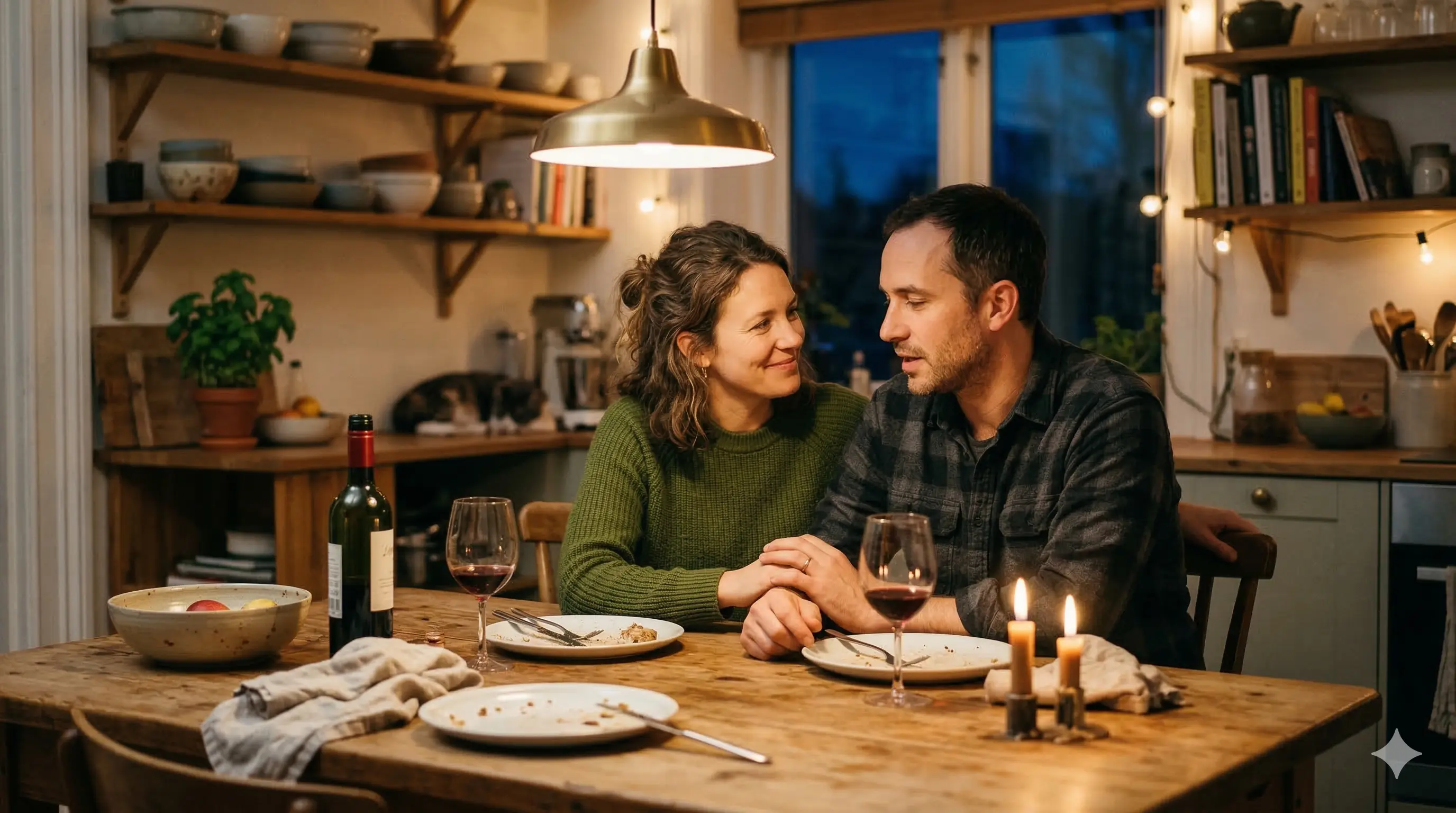
Quality Time in a Relationship: Why It's So Hard to Get

You spend most of your evenings in the same apartment. You eat together, sleep in the same bed, share a bathroom. And yet somehow, at the end of the week, you realize you haven't really been present with each other in days.
This is one of the quiet paradoxes of modern relationships. Proximity is easy to come by. Quality time in a relationship is something else entirely.
The difference between time together and quality time
Time together is just occupying the same space. Quality time requires something more: mutual attention, some degree of engagement, and the absence of whatever usually pulls you elsewhere — your phone, the news, the running list of things you haven't done yet.
The tricky part is that quality time doesn't announce itself. It doesn't show up on a calendar. It has to be created — and in the middle of busy lives, creating it consistently is harder than most couples expect.
Why it keeps slipping away
The usual suspects are obvious: work, tiredness, screens. But there's a subtler reason too. Quality time requires a certain kind of effort that, after a long day, feels like the last thing you have capacity for. So you default to the easiest option — sitting in the same room, half-watching something, technically together but not really.
This isn't a failure. It's just the path of least resistance. The problem comes when it becomes the default, week after week, and the gap between physical proximity and genuine connection quietly widens.
What actually works
The couples who manage this well tend to do one thing differently: they treat quality time as something that needs to be structured, not just hoped for. Not in a rigid, scheduled way — but with enough intentionality that it actually happens.
A few approaches that consistently work:
Replace passive time with active time. Instead of defaulting to something you both watch separately, choose something you do together — cook a meal, go for a walk, play a game. The engagement level changes everything.
Make it low-effort to start. The barrier to quality time is often getting started. The easier the activity is to initiate, the more likely it actually happens. A complicated dinner reservation is harder to commit to than just deciding to cook something together at home.
Protect a window, not a whole evening. You don't need three hours. Even ninety minutes of genuine presence — phones away, attention on each other — does more for a relationship than an entire evening of parallel distraction.
The real goal
Quality time isn't about doing something impressive or memorable. It's about being genuinely present with the person you chose — which is easier said than done, but also simpler than it sounds once you stop waiting for the right conditions and just start.
The conditions are never perfect. The evening is never ideal. But the connection you build in ordinary moments is what a relationship is actually made of.
Cookbond is designed for exactly this kind of evening — low effort to start, genuinely engaging once you're in it. Cooking together with a clear structure and defined roles turns an ordinary weeknight into something that actually feels like time well spent.
Quality time doesn't have to be complicated. It just has to be intentional.